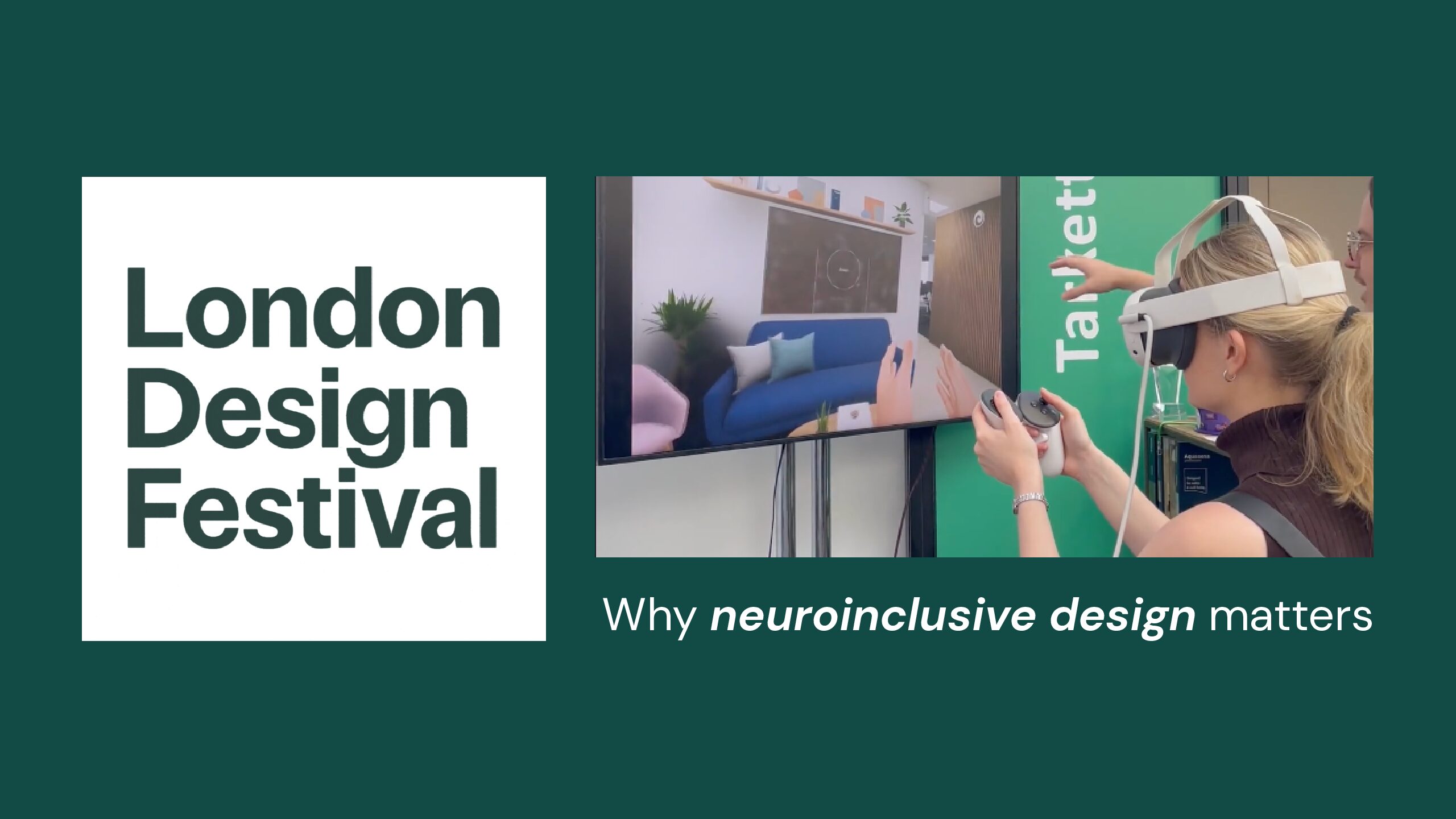
London Design Festival: Why neuroinclusive design matters
Forget Fashion Week. From a property perspective, one of the biggest events in London’s September calendar is London Design Festival. I’m Isabel and I’m a Senior Account Manager at BR and this year, I was lucky enough to explore the showcases across Shoreditch myself.
From interiors at the Barbican to beautiful textiles and appliances at Shoreditch Town Hall, the capital was bustling with creativity. But one exhibition in particular stood out to me: “Neuroplaces”.
Part of the Shoreditch Design Triangle, Neuroplaces was dedicated entirely to neuroinclusive and accessible design, showcasing products and ideas designed to make everyday spaces work better for different people.
Its founders, Nathan and Eliza Reuby, are calling for neuroinclusive, universally designed spaces to be the norm. Inspired by their experience as parents of an autistic child, they are challenging designers to think more carefully about how neurodivergent and disabled people experience the world around them.
This idea is still relatively new. The term “neurodiversity” itself only emerged in the 1990s, while sensory considerations, such as softer lighting and quiet zones (my personal favourite), have gradually become more prominent in design since then.
The fact that Neuroplaces was the first exhibition of its kind during London Design Festival perhaps says it all.
At the same time, neurodiversity has become an increasingly contentious topic in the media. Rising diagnoses of autism and ADHD are frequently questioned and scrutinised, while social media platforms such as TikTok have faced criticism for content that can oversimplify complex conditions and spread misinformation.
Amid all this noise, it was refreshing to see something so practical in such a positive, inclusive environment. Neuroplaces showcased wonderful designers and entrepreneurs creating tangible solutions to make people’s everyday experiences better.
From sensory quiet spaces for busy locations such as train stations and offices, to adaptable lighting and ergonomic furniture, it demonstrated how relatively simple design decisions can make spaces more accessible for everyone.
It really got me thinking, and after visiting Neuroplaces, I came across an article by Harry Wallop in The Times looking at whether hot-desking has made the office a lonelier place. He argued that the rise of hot-desking has made many workplaces quieter and less sociable, disrupting the everyday interactions and workplace friendships that come from regularly sitting alongside the same people.
Despite the article not centring on neurodiversity at work, many of the issues he raised echoed what I had seen at the exhibition.
One particularly interesting point was that hot-desking can present specific challenges for some employees. For an autistic person, having the consistency of the same desk may be important to their routine. For someone who is deaf or hard of hearing, the position of their desk might affect their ability to lip-read colleagues.
Research referenced in the article suggested that employees who rated hot-desking most negatively tended to face a “sea of identical desks”. Those with more positive experiences had access to a mix of collaboration spaces, phone booths, meeting rooms and focused areas, allowing them to choose where to work depending on what they needed and preferred.
While Wallop’s article focused on getting people talking in the office again, I think there’s a wider point to take from it: different people need different things from the spaces around them.
A bright, open-plan office might energise one employee and overwhelm another. One person might thrive in a busy communal area; someone else may need somewhere quiet to concentrate. The same principle applies to schools, shops, stations and other public spaces.
For employers, developers and designers, that means thinking beyond how a space looks and feels to them, and to instead consider how it will impact the range of people using it.
With an estimated 15-20% of the population thought to be neurodivergent, there is a strong case for our built environment to do more to accommodate these different needs.
This is certainly something I’d like to see a lot more of at next year’s London Design Festival – and, more importantly, in the places we use every day.
Contact us
If you want your organisation to join the media conversation around neuroinclusive design, or you offer a solution that could help property brands create more accessible spaces, get in touch at brprteam@building-relations.co.uk.