Regenerative Design: Transforming London’s Buildings & Boroughs
Reuse, Respond, Regenerate…
Delivering 1.5 million homes remains the echoing promise within Government, and while its urgency cannot be denied, we must raise the question: what type of homes do we want to build? Affordable homes, energy efficient homes, sustainable homes, regenerative homes, or all of the above…
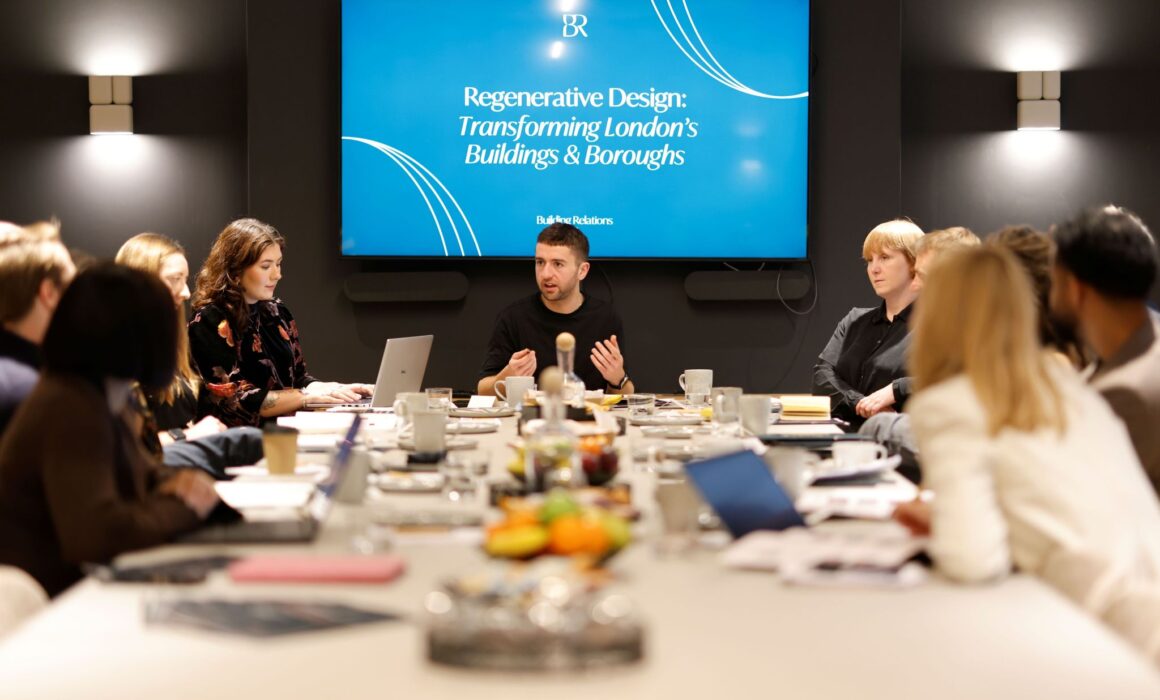
Last week, Building Relations brought together key built environment stakeholders for a discussion on the role that regenerative design has in shaping London’s housing industry.
The closed roundtable, with representatives from London boroughs, businesses, architects and developers, saw collective agreement that regenerative design can become a transformative force in the capital’s housing industry.
What is Regenerative Design?
A question with many answers, that’s for sure, but regenerative design is essentially a housing design approach that enables the built environment to giveback to the environment and the local community. This sounds fairly simple, but let’s break it down. In a way that developers must deliver a Biodiversity Net Gain (BNG) of 10% on new sites, ensuring that habitats for wildlife are left in a measurably better state than they were before the development, regenerative design takes this a few steps further to deliver and create homes that are not only better for the environment but for people that live in them.
Philosopher Roman Krznaric argues that a good ancestor has to account for seven generations ahead when making decisions today. However, the current delivery model of homes rarely delivers benefits that endure even a fraction of that time.
So, how can we make regenerative design the new norm for today’s generations and the seven more to come?
Data and Policy
Policymakers need quantifiable data to ensure evidence-based decision-making, and as “regenerative” principles are not yet measurable or standardised enough across the industry, there is no policy to influence decisions or provide clear definitions. Without data, it is difficult to drive change as it is hard to determine what really works.
Clearer frameworks, simplified guidance, and alignment across standards like Net Zero, BREEAM, and Passivhaus, which give stakeholders a clear framework on how to achieve key deliverables within these standards, needs to be replicated for regenerative design. To get the ball rolling, there is an urgent need for education on regenerative design across the industry, open data sources, and an open forum or taskforce to unlock the barriers to delivering regenerative design.
Risk it all and (hopefully) reap the rewards
Large-scale residential projects often lack innovation due to risk and financial pressure which can be addressed through collaboration with viable partners. Smaller schemes naturally allow for experimentation and collaboration which is a good opportunity to trial new things and evaluate their viability for larger schemes.
Incentives such as tax breaks as well as research and development credits will encourage and foster an environment within the industry for developers and housebuilders to collaborate or take on more regenerative approaches. For example, the removal of VAT on refurbishment discourages reuse of materials and buildings, and has been a major barrier to both circular and regenerative practice.
Go beyond circularity
Current standards prioritise the efficiency of buildings but not necessarily regeneration, which calls for a symbiotic approach to give back to the environment. As an industry, it is important go beyond simply reusing construction materials to creating net-positive systems, moving from linear to circular models like growing materials on site, building a solar farm on extra plots and bringing in agriculture.
Community engagement and stewardship
Meaningful community engagement is a key part of regenerative design, ensuring that a housing development benefits the existing community and future communities, and if it doesn’t – taking on feedback until it does.
Stewardship requires maintenance and long-term management, so developers and designers should build this into their budgets.
While there are a number of incentives to get building quickly, these incentives are not extended to the long-term management of homes and developments which can often result in stewardship dropping to the bottom of list.
However, the industry should see this as an opportunity to also create jobs through maintenance, such as ground-floor ‘janitor’ flats to house an on-site maintenance person.
Consider the role of nature and placemaking
The UK Nature Rights Bill was introduced in the House of Lords in October 2025 with the aim of establishing a legal duty of care towards nature. Should this bill pass, nature-connected design with urban greening, BNG, and landscape-led placemaking will go a long way in improving health and wellbeing, which are tangible outputs for regenerative design.
Think far beyond London
The London-centric focus within the housebuilding market leaves other UK regions behind when it comes to innovation. There is a need to move from compliance-based design to outcomes-led design. The industry must redefine what “good” looks like beyond just compliance and efficiency to include long-term resilience, joy, and regenerative impact.
In conclusion…
The property market should not only deliver much-needed homes but also regenerate the environment where these schemes are placed.
To enhance communities and truly deliver a regenerative approach across both new and existing homes, a clear framework will be key to ensure this is deliverable and to evaluate processes. Education on regenerative design will be key in driving the regeneration of the housing industry, and public relations (PR) is putting its best foot forward, creating open spaces for professionals to discuss. By engaging in important topics that don’t make it into mainstream conversations, PR is bridging gaps between developers, housebuilders, government bodies, and councils to unlock partnerships that enhance knowledge exchange and a wider impact.
Regeneration in PR is about recreating the ideas and shaping the knowledge we hold as an industry to drive conversation that presents change.
To find out more about regenerative design in PR, please get in touch with us at pr@building-relations.co.uk.